In a nutshell
- 🌱 Baking soda can raise pH in minutes in water, sprays, and low-buffer media, delivering rapid but short-lived nutrient availability gains.
- 🧪 pH controls crop nutrition: too low locks phosphorus, too high limits iron/manganese; crop-specific ranges matter for brassicas, potatoes, and blueberries.
- 🛠️ Follow field protocols: 1–2 g/L solutions, small test plots, meter checks after 10–20 minutes; treat it like a lab experiment and record before/after data.
- ⚠️ Watch sodium accumulation and structural damage in soils; avoid whole-bed corrections—use lime to raise pH or elemental sulphur to lower it for durable changes.
- 🇬🇧 In the UK, hard water adds alkalinity; consider citric/phosphoric acid for irrigation, use gypsum if sodium builds, and plan ahead for clubroot-prone brassica beds.
Gardeners and growers increasingly talk about tailoring soils in real time. The promise is alluring: use a pinch of baking soda (sodium bicarbonate) to nudge pH and unlock nutrients, right when crops need them. In some situations, yes—changes can register in minutes. But speed is not the same as staying power. The soil’s buffering capacity fights back. Small, localised tests can be decisive, while blanket use can backfire. Here’s a clear, evidence-led guide to what happens chemically, when rapid tweaks make sense, and how to run safe, repeatable trials on UK plots, lawns, and polytunnels without risking salt build-up or stunting your brassicas and salads.
Why pH Matters to Crop Nutrition
Soil pH is not fashion; it is a control knob for nutrient chemistry. At lower pH, phosphorus can lock up with iron and aluminium, while at higher pH, iron and manganese become less available, inviting chlorosis in leafy crops. Get pH wrong and plants show hunger even in fertile ground. Brassicas generally thrive around 6.5–7.2, with clubroot pressure reduced in the upper part of that window. Potatoes, conversely, accept slightly acidic conditions and may suffer scab if pushed too alkaline. Blueberries are the outliers, demanding acid—often 4.5–5.5—ideally in peat-free, low-buffer media.
pH also steers microbial traffic. Nodulation in legumes responds to acidity, and many pathogens tip the balance if the hydrogen ion concentration shifts their way. On UK allotments and market gardens, a modest swing can decide whether tomatoes mine enough magnesium in a cool summer or whether onions take up the calcium they crave for cell walls. The catch is that soils resist abrupt changes. Clay content, organic matter, and carbonates act like sponges, absorbing the shock. Fast moves are easier in low-buffer composts than in heavy, calcareous clays.
The Science: How Baking Soda Raises pH in Minutes
Sodium bicarbonate (NaHCO₃) dissolves quickly, releasing bicarbonate ions that mop up free hydrogen ions: HCO₃⁻ + H⁺ → H₂CO₃ → CO₂↑ + H₂O. That neutralisation nudges the solution pH upward immediately. In potting mixes and irrigation water, the shift is near-instant and measurable with a meter or indicator strips. The “minutes” claim is true—but it refers to the soil solution or spray mix, not the bulk soil matrix. As CO₂ escapes and exchange sites on clays and organic matter donate more H⁺, pH drifts back unless more alkalinity is supplied.
Two constraints limit the effect. First, buffering capacity: clays and humus store acidity or alkalinity, dampening any spike. Second, sodium itself. Repeated bicarbonate additions accumulate Na⁺, which can disperse clays, sealing surfaces and reducing infiltration. The rapid-change niche is therefore targeted: a foliar spray to raise spray tank pH for better stability of certain actives, a micro-drench to push compost-grown herbs from 5.8 to 6.3 before a key flush, or a quick tweak of alkaline irrigation water. Heavy UK loams with free lime may barely budge, whereas a peat-free seed mix can respond noticeably.
Field Protocols: Safe, Small-Scale Adjustments
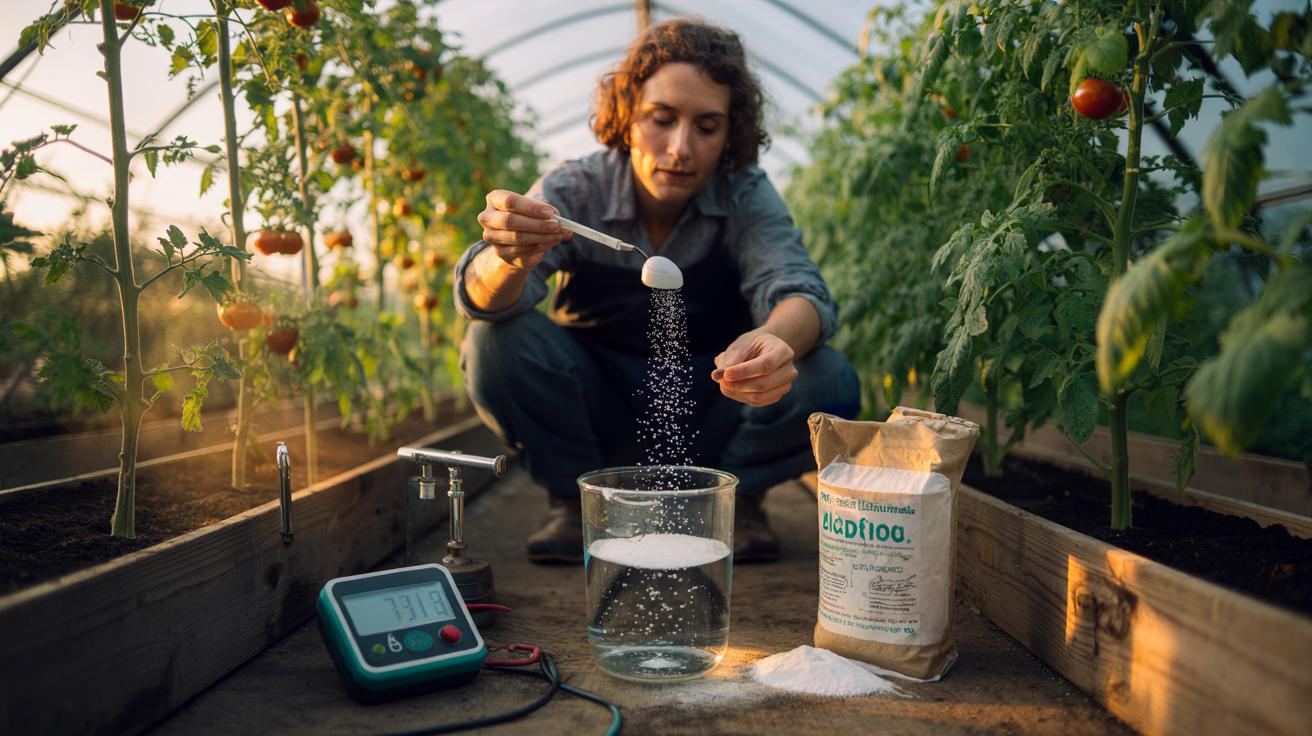
Approach fast pH work like a lab experiment. You’ll need a digital pH meter or fresh indicator strips, distilled water, a 1–2 litre hand sprayer, and a kitchen scale accurate to 0.1 g. Mix a mild solution: 1–2 g baking soda per litre of water (about ¼–½ teaspoon). For a soil or compost drench, apply 0.5–1.0 L per m² on a marked test square. Wait 10–20 minutes, then sample a 1:2 soil–distilled water slurry and measure pH. If you see a rise greater than 0.5 pH units, stop and reassess. For foliar work, use the same dilution, test on a few leaves at dusk, and check for scorch within 24 hours.
Avoid repeating drenches more than once a week, and never stack bicarbonate on sodium-prone soils or in greenhouses where salts build quickly. If EC climbs or leaves crinkle, flush with clean water and consider gypsum (CaSO₄) to displace sodium. Keep trials crop-specific: salads and cucumbers dislike sudden osmotic changes; rosemary in containers tolerates them better. Always record the mix, rate, pH before/after, and visual response—data that turns hunches into practice.
| Method | Mix Rate | Application | pH Shift Seen | Timeframe | Notes |
|---|---|---|---|---|---|
| Soil/compost drench | 1–2 g/L | 0.5–1.0 L/m² | +0.2 to +0.6 | 10–30 min | Stronger in low-buffer media |
| Foliar spray | 1 g/L | Light coverage | Spray solution only | Immediate | Patch test to avoid scorch |
| Irrigation tank adjust | 0.5–1 g/L | As needed | +0.3 to +0.8 (water) | Immediate | Monitor runoff EC/sodium |
Risks, Limits, and Longer-Term Alternatives
The ultra-fast shift comes with strings. Sodium accumulates, dispersing clays and reducing structure; bicarbonate can push media alkaline enough to trigger iron chlorosis in strawberries, blueberries, and ornamentals. Do not attempt whole-bed corrections with baking soda. If your soil test calls for a pH lift, use garden lime (CaCO₃) or dolomitic lime for magnesium, applied typically at 100–200 g/m² depending on texture and current pH, then retest after 8–12 weeks. For lowering pH, choose elemental sulphur or acidifying fertilisers, accepting that biology needs time to work.
In the UK, hard water often carries bicarbonate alkalinity that creeps pH upward in containers; acidifying irrigation with citric acid or phosphoric acid—carefully dosed and measured—is a safer systemic fix than chasing with soda. If you suspect sodium build-up, incorporate compost for resilience and consider gypsum to rebalance cations without altering pH. Before planting brassicas into clubroot-prone beds, lime months ahead rather than firefighting mid-season. When in doubt, follow RHS guidance or seek a FACTS-qualified agronomist. Short-term hacks should serve long-term soil health, not undermine it.
Used with care, baking soda can customise local pH in the moments that matter—seeding, transplanting, or fine-tuning compost-grown herbs. The chemistry is rapid, the effects are real, yet they are bounded by buffering and the risk of sodium accumulation. Think “scalpel”, not “sledgehammer”: measure, trial, observe, record. If a micro-adjustment unlocks nutrients today, follow it with sound amendments that carry crops through the season. As you plan your next planting, where could a minute-scale pH tweak sharpen performance—and what data will you collect to prove it?
Did you like it?4.4/5 (26)