In a nutshell
- 🌱 Eggshell powder = calcium carbonate that raises soil pH, unlocking nitrogen and phosphorus and explaining the quick green-up as nutrient availability improves.
- 💧 Calcium promotes flocculation for better structure, aeration, and drainage; healthier roots follow. Target pH 6.0–6.5 for most UK turf.
- 🔧 Prep and apply right: rinse, bake, and grind very fine; broadcast ~50–100 g/m², brush in, and avoid applying alongside iron or ammonium sulphate (separate by two weeks).
- 🛡️ Adequate calcium strengthens cell walls and stress tolerance, but over-liming can cause iron/manganese lockout—watch the Ca:Mg ratio and supplement iron if needed.
- 📊 Evidence supports eggshells’ neutralising value when finely ground; limits include variable fineness and supply. It’s a circular, low-cost amendment—but start with a soil test.
Britain’s lawns have a new ally sitting quietly in the kitchen. Finely ground eggshell powder is being scattered over turf by thrifty gardeners who swear it greens grass quickly and sustains that colour through the season. The secret is not a mystery fertiliser but a classic soil fix: calcium carbonate. By nudging soil pH upward and improving structure, calcium can unlock nutrient availability and invigorate roots. Results can be dramatic on acidic or compacted soils. Yet this isn’t a silver bullet. It’s a tool, and tools need a plan. Always test your soil before liming, however “natural” the source may be. Used well, eggshells turn waste into lawn health.
How Calcium from Eggshells Interacts with Soil Chemistry
Eggshells are roughly 95–97% calcium carbonate (CaCO3), the same active agent found in agricultural lime. When finely milled, CaCO3 reacts with acidic soils, neutralising hydrogen ions and slowly raising pH. That shift can transform a lawn. Nitrogen from past feeds mineralises more readily, phosphorus becomes more available within a favourable pH window, and toxic aluminium is subdued. The “quick green-up” many report often reflects improved nutrient availability rather than a direct fertiliser effect. Calcium itself is also a nutrient, stabilising cell walls and aiding root growth, but the headline impact is chemical: a kinder medium for grass to feed within.
There’s a physical dimension, too. Calcium promotes flocculation, the clumping of clay particles into stable aggregates. Better aggregation means improved porosity, less surface crusting, and quicker drainage after rain — conditions that roots love. Healthier roots explore more soil, capturing potassium, nitrate, and water with less stress. Microbial life benefits as well; an active microbiome drives organic matter breakdown, releasing a steady trickle of nutrients. That said, excess liming risks locking up iron and manganese, tipping leaves towards chlorosis. Balance is the watchword: aim for pH 6.0–6.5 for most UK turf.
From Kitchen Waste to Turf Tonic: Preparing and Applying Eggshell Powder
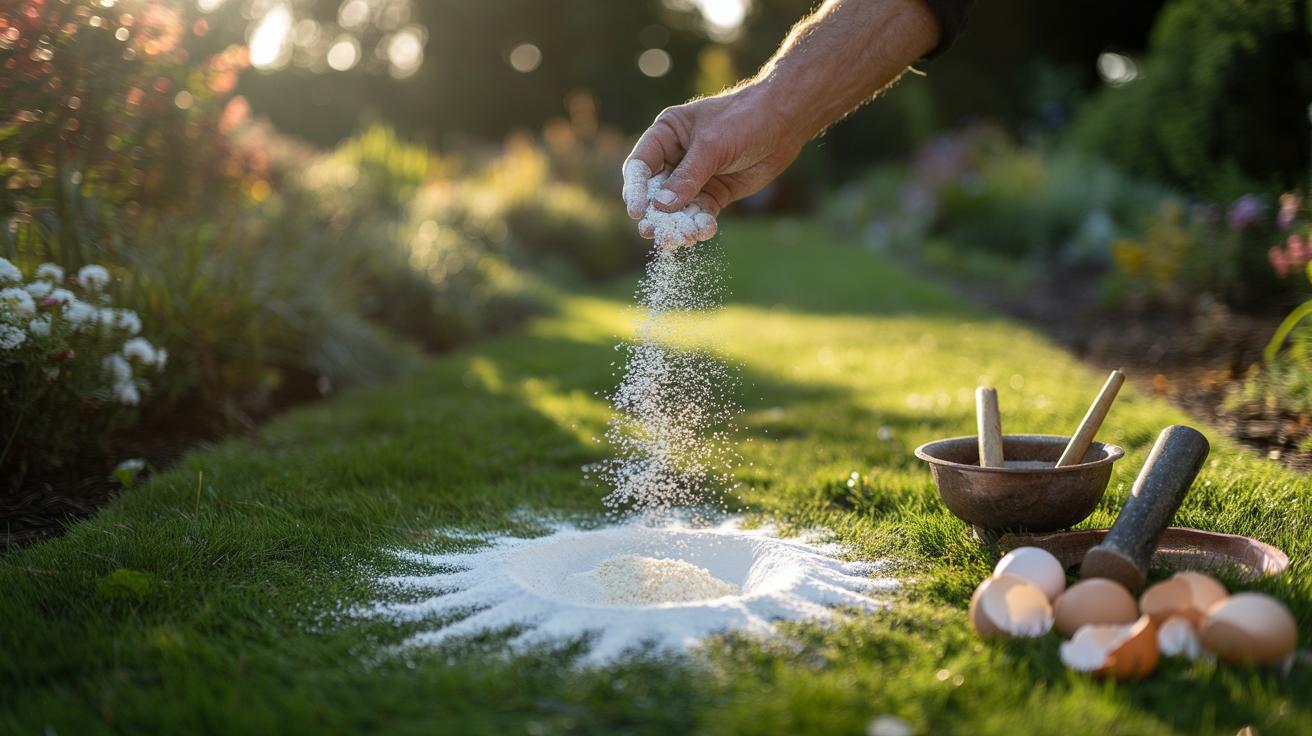
Rinse shells, dry thoroughly, then bake at 160°C for 10–15 minutes to sanitise and make them brittle. Grind to a fine powder; the finer the grind, the faster the reaction in soil. A coffee grinder or mortar and pestle works, but a short burst in a high-speed blender delivers uniform particles. Sift if you can. Fine powder integrates into turf thatch and topsoil quickly and avoids unsightly white flecks. Coarse fragments look rustic but react slowly and unevenly.
Application is simple. On an established lawn, broadcast a light dressing after mowing and before rain, then brush in with a stiff broom. Typical light-rate guidance, assuming mild acidity and fine powder, is 50–100 g/m². Heavier, one-off doses are rarely wise without a soil test. Repeat modestly in spring and autumn if pH remains low. Avoid applying at the same time as iron sulphate lawn treatments or ammonium sulphate feeds; separate by two weeks to prevent neutralisation.
| Lawn Area | Eggshell Powder (Fine) | Suggested Frequency |
|---|---|---|
| 10 m² (small patch) | 0.5–1.0 kg | 1–2 times per year |
| 50 m² (typical garden) | 2.5–5.0 kg | 1–2 times per year |
| 100 m² (large lawn) | 5.0–10.0 kg | 1–2 times per year |
Do not expect eggshells to replace nitrogen. Pair with a balanced turf feed and sensible watering for best results.
Nutrient Balance, pH, and Disease Resistance in Lawns
Calcium sits at the heart of turf physiology. It strengthens cell walls, supports membrane integrity, and moderates stress responses. In practice, lawns with adequate calcium tend to show firmer leaf blades and more resilient crowns. That resilience matters under mowing, foot traffic, or summer heat. Better structure and pH also influence the microbiome and thatch dynamics, often reducing black layer risk and improving recovery after wear. Some turf diseases exploit weak tissues; while calcium isn’t a fungicide, it can tilt the odds. Stronger walls, fewer leaky cells, less stress — conditions many pathogens dislike.
Balance remains critical. Over-liming can shift the scales, making iron and manganese less available and inviting pale, washed-out colour. Grass wants pH in the moderate zone. Pair calcium improvements with judicious iron for cosmetic greening, and maintain a sensible Ca:Mg ratio for root function. Eggshells also carry traces of phosphates and organic compounds, but their fertiliser value is modest. The real win is the slow, steady coaxing of soil back towards a supportive chemistry. If your pH is already near neutral, hold off — the law of diminishing returns applies quickly.
Evidence and Limitations: What Science Says About Eggshell Lime
Analyses routinely show eggshells at 95–98% CaCO3 with a neutralising value comparable to high-purity lime when ground finely. The catch is fineness. Standard lime is milled to strict particle sizes for predictable reactivity; DIY eggshell powder varies. Some gardeners see fast responses because they’ve achieved talc-like powder and applied to distinctly acidic soil. Others see little because fragments are coarse or pH was already fine. Expectation should match materials: this is a slow-release conditioner, not an instant feed.
There are practical limits. Collecting enough shells for big lawns is laborious. Store-bought lime remains cheaper per square metre and more consistent. Hygiene matters, too; baking is essential to avoid odours and pests. And while eggshells are generally clean, avoid shells with visible contaminants. The sustainability case still holds: diverting waste from the bin, returning minerals to soil, and reducing demand for quarried lime has value. For the careful lawnkeeper, eggshells become a circular, low-cost amendment that complements, rather than replaces, a smart turf programme.
Handled thoughtfully, eggshell powder can be the nudge that turns a tired sward into a confident, richly coloured lawn. It moderates acidity, knits soil crumbs, and gives grass a friendlier rooting zone — all while making clever use of kitchen waste. Yet the best lawns are built on measurement and moderation, not myth. Test, apply lightly, observe, adjust. Combine calcium conditioning with proper mowing heights, seasonal feeding, and good drainage, and the results stack up. Will this be the year you grind your breakfast leftovers and run a small, evidence-led trial on your own patch of green?
Did you like it?4.4/5 (30)