In a nutshell
- 🧊 The Provençal well (puits provençal) is a ground-coupled heat exchanger that precools incoming air via buried pipes, delivering 5–7°C drops during heatwaves by exploiting the soil’s steady 12–17°C.
- 🏛️ Rooted in the Napoleonic era, this low-tech method is being revived across France, with architects and municipalities backing it to cut peak demand and carbon while enhancing comfort.
- 🛠️ Typical setup: HDPE/PVC pipes 150–200 mm, 25–50 m long, buried 1.5–2.5 m deep, with 2–3% slope, drain, intake filter, and efficient fan; installed cost roughly €3,000–€8,000.
- ⚠️ Key cautions: keep pipes smooth and dry to avoid mould, steer clear of polluted soils, and in mapped areas monitor radon with airtight joints and proper drainage.
- 🌿 Pairing with passive cooling—external shutters, night flushing, high thermal mass, light façades, and clay-jug evaporative cooling—compounds benefits for cool, sleep-friendly interiors.
As French summers turn fierce, a curious revival is underway: families are cooling their homes with a technique their great-great-grandparents knew. The method, rooted in early 19th-century practice, trades humming compressors for buried pipes and clever masonry. It’s quiet. It’s frugal. It’s surprisingly modern. Engineers call it a ground-coupled heat exchanger; locals know it as the Provençal well or puits provençal. In the age of heat pumps and smart thermostats, this low-tech alternative is winning converts because it slashes energy bills and carbon without sacrificing comfort. This 200-year-old idea cools homes without refrigerants, noise, or glare-inducing outdoor units. And in towns from Lyon to Limoges, it is becoming a summer essential.
What Is the Provençal Well and Why It Works
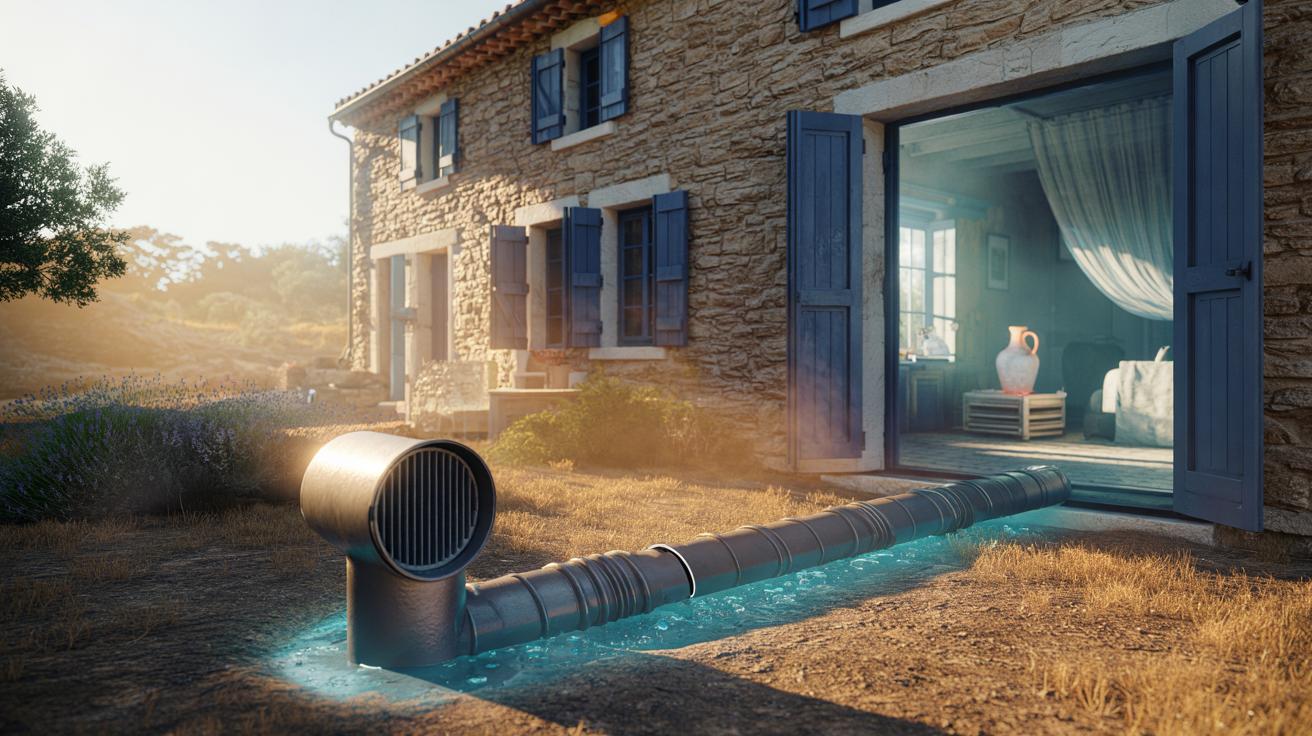
The principle is disarmingly simple. A Provençal well draws outside air through a long, buried pipe before it enters a house. A few metres underground, the soil stays near a stable temperature all year—typically 12–17°C in France—so the pipe exchanges heat with the ground. On a 35°C afternoon, air arriving indoors can be several degrees cooler, sometimes by 5–7°C in ideal conditions. That reduction feels dramatic during a heatwave. By leveraging the earth’s steady temperature, a house gains passive cooling without electricity-hungry machines.
Technically, it’s a ground-coupled heat exchanger, and it relies on three rules. First, length matters: longer pipes offer more contact with cool soil. Second, flow must be balanced: too fast, and air doesn’t cool; too slow, and humidity can condense. Third, hygiene is crucial: filters and smooth, properly sloped pipes prevent mould. Paired with the high thermal inertia of French stone or brick, the system keeps rooms temperate even as streets bake.
From Napoleon’s Engineers to Today’s Suburbs
The technique’s French story threads through the early 1800s, when military engineers and estate builders experimented with buried ducts to temper air in cellars, ice houses, and storage rooms. As the Empire grappled with logistics—from preserving food to safeguarding powder—practical ventilation solutions spread to rural properties and townhouses. The knowledge never vanished. It simply went quiet as coal-fired and then electric cooling eclipsed it. Today, a warming climate is reversing that logic.
Architects in Occitanie retrofit 1930s villas with discreet puits provençaux. New-builds near Nantes integrate them from the foundation stage. Municipalities offer small grants within broader energy renovation programmes because the systems reduce peak power demand. In the hottest weeks, shaving 3–7°C off indoor temperatures can be the difference between sleep and exhaustion. Builders adapt details to local geology—shallow trenches in sandy soils, deeper runs where clay dominates. The appeal is cultural as much as technical: a French fondness for simple, durable solutions that respect older materials.
Installing a Provençal Well: Costs, Materials, and Pitfalls
Most homeowners choose high-density polyethylene (HDPE) or PVC pipes, 150–200 mm in diameter, buried 1.5–2.5 metres deep, with a run of 25–50 metres depending on plot size. A gentle slope (2–3%) toward a drain or sump carries away condensate. An intake hood with insect mesh, a G4–F7 filter, and a small, efficient fan complete the setup. Expect €3,000–€8,000 installed, less if self-built with guidance. The golden rule: dry, smooth, and well-drained pipes prevent odours and mould.
| Component | Role | Typical Specs |
|---|---|---|
| Buried pipe | Heat exchange with soil | HDPE/PVC, 150–200 mm, 25–50 m |
| Slope & drain | Condensate management | 2–3% slope, trap/sump |
| Air intake | Clean, controlled inflow | Hood, mesh, G4–F7 filter |
| Fan & controls | Optimise airflow | Low-SFP fan, hygro/CO₂ sensor |
Two cautions matter. Avoid routes near septic lines or polluted soils. And check regional radon maps; in higher-risk areas, fit airtight joints and monitor levels. Commissioning is straightforward: pressure-test, flush, then balance airflow with window strategy for summer nights. That’s it.
Beyond the Well: Complementary Low-Tech Moves
A puits provençal shines when paired with classic French know-how. External shutters (persiennes) stop solar gain before it enters. Night flushing purges daytime heat, the well pre-cools incoming air at dawn. Thick lime–stone walls add thermal mass; light-coloured façades reflect radiation. In the south, some households revive a Napoleonic-era trick popularised after the Egyptian campaign: evaporative cooling with porous clay jugs—gargoulettes—set in breezeways to chill air gently. It’s small, but noticeable.
Indoors, rearrange heat sources. Move freezers to cellars. Swap halogens for LEDs. Seal leaky loft hatches that spill hot air downward. Smart blinds and a simple hygrometer help time ventilation to when humidity is low enough for comfort. Passive measures stack; each contributes a degree or two until a sweltering day feels manageable. The result isn’t Arctic cold, but a steady, humane cool that makes living rooms livable and bedrooms sleep-ready.
France’s embrace of this old-new cooling method is pragmatic, almost tender—a respect for the ground beneath our feet and the buildings that rest on it. As energy prices wobble and heatwaves lengthen, a Provençal well offers resilience without complexity, and comfort without guilt. It’s not a silver bullet, and it demands care in design and maintenance, yet its elegance is hard to ignore. When the mercury jumps, homes built on quiet physics keep their poise. If your street roasted last August, would you consider burying a little 19th-century wisdom in your garden?
Did you like it?4.5/5 (26)