In a nutshell
- 🧂 Salt is hygroscopic; adding rice acts as a tiny desiccant and spacer, absorbing moisture immediately to stop micro-bridges that cause clumping.
- 💧 Inside a shaker, humidity condenses and fuses crystals; rice “drinks” faster, stabilising a better microclimate and keeping flow consistent—helped by snug lids and sensible hole sizes.
- 🌾 Choose long‑grain white rice, use sparingly (about 1 tsp per 100 g salt), mix through the bed, and refresh or oven-dry periodically; if salt already has anti‑caking agents, use even less.
- 🧰 Alternatives: a piece of dried pasta (spacer), oats (absorbent but dusty), or food‑grade desiccant sachets—avoid non‑food silica gel and keep packets contained.
- ✅ Practical myths and tips: rice won’t strip iodine from fortified salt; more rice isn’t better—too many grains can clog and reduce flow.
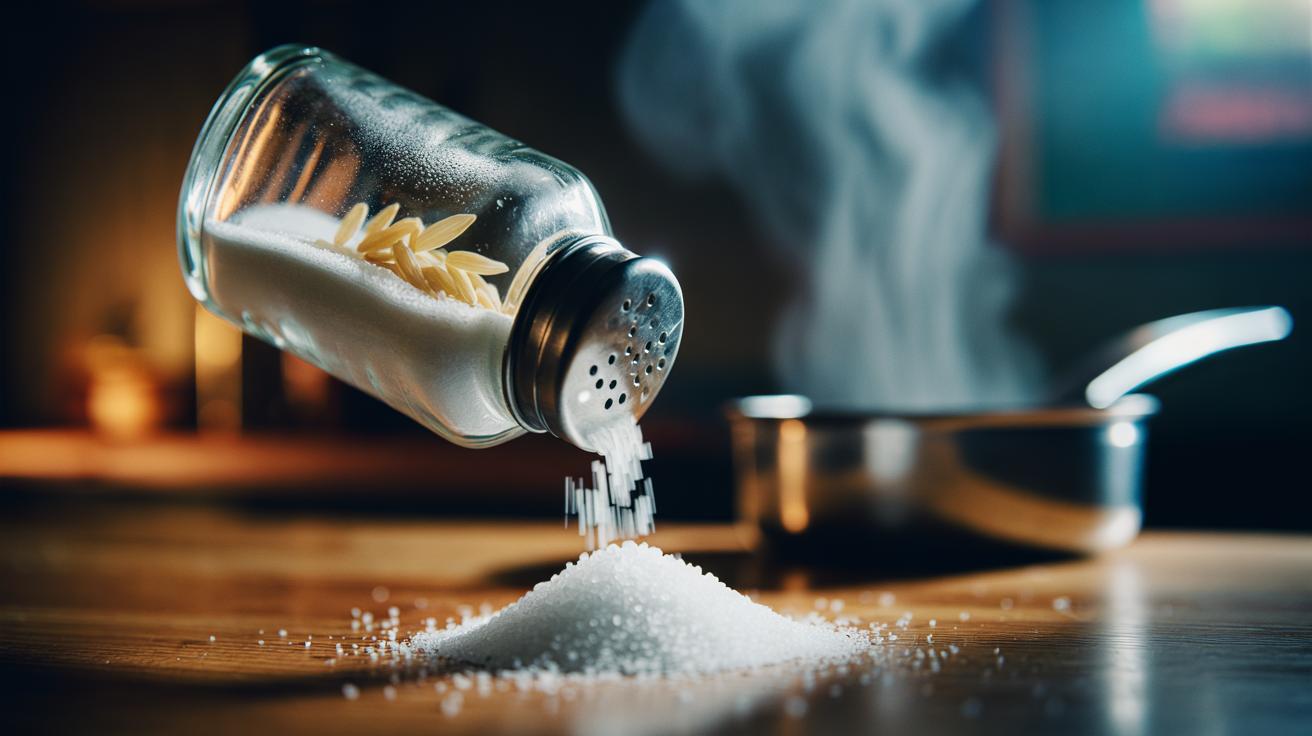
Every British kitchen seems to inherit the same folk wisdom: drop a few grains of rice into the salt shaker and the crystals will pour freely, whatever the weather. It’s not just quaint habit. There is a neat bit of physics and food chemistry at play. Table salt is hygroscopic, eager to pull water from humid air; damp salt forms bridges and clumps. Rice, by contrast, acts as a tiny desiccant and a physical spacer, grabbing the first droplets and keeping crystals apart. That first split second matters. Stop the earliest beads of moisture and you stop the chain reaction that turns free-flowing salt into a stubborn lump.
Why Salt Clumps and Rice Stops It
Salt doesn’t simply “get wet.” It dissolves microscopically at crystal surfaces as ambient moisture condenses, then re-crystallises as conditions change, welding neighbouring grains together. Those micro-bridges grow; clumps follow. In a steamy kitchen this process accelerates, especially when a warm pan sends humid plumes past the shaker. Without intervention, the flow rate collapses. That’s why an older shaker sometimes needs a hard shake or even a skewer to break the agglomerates.
Enter rice. Each grain offers a rough, starch-rich surface with internal pores that sequester small amounts of water. Starch granules inside the rice act like tiny sponges while the hard outer surface spaces salt crystals apart, interrupting those bridge points. By soaking up the first traces of moisture, rice prevents salt from dissolving and re-gluing itself. It’s a two-part defence: absorb and separate. The effect is local and immediate; a few well-placed grains mixed through the salt bed can make the difference between a silky sprinkle and a stubborn clod.
There’s a second bonus. Rice grains are larger than salt crystals, so they create micro-channels through the bed. Those voids help air move and prevent pressure compaction. Think of the rice as scaffolding: simple, inert, and very effective in small amounts.
Moisture Dynamics Inside a Shaker
Humidity sneaks in each time you open the lid or shake over steaming food. Warm air enters, cools against the container walls, and condenses—small droplets then wick onto nearby solids. Salt, being hygroscopic, is the first to notice; its surface film becomes briny, primed to fuse with neighbours. This is the critical moment when rice must “drink” faster than salt can dissolve. Because rice grains have more bulk and less ionic attraction to water than salt, they preferentially host those initial droplets.
Distribution matters. If rice sits on top, it intercepts moisture before it diffuses deeper; mixed lightly throughout, it establishes multiple “sacrificial” sinks that capture water at several layers. The result is a more stable microclimate inside the shaker—less oscillation between wet and dry, fewer recrystallisation cycles, better flow. Short, sharp humidity spikes, such as when seasoning simmering soup, are blunted. Long, damp days are made tolerable. You won’t achieve laboratory dryness, but you will avoid the threshold at which salt begins to cake and bridge.
Container design helps too. A snug cap, fewer and smaller holes, and non-porous walls reduce moisture ingress. Yet even with a basic shaker, the rice trick buys valuable margins, especially in coastal homes or during rainy spells when indoor relative humidity can soar.
Choosing the Right Rice and Setup
Not all rice behaves the same. Choose long-grain white rice—plain, uncooked, unwashed. It’s low in oils, hard, and relatively dust-free. Brown rice contains more lipids that can stale over time; aromatic varieties carry scents you may not want in your salt. Short-grain types break and shed starch dust, which can cloud a shaker. Aim for a teaspoon of rice per 100 g of salt as a starting point; you’re building a scaffold, not a second ingredient. A little rice goes a long way.
Mix the grains gently through the salt rather than dumping them on top. If your shaker has fine holes, tuck the rice in a small square of muslin or a tea-infuser ball to keep pieces from clogging. Refresh the rice monthly in damp seasons. To revive, spread the rice on a tray and dry it on low heat in the oven for 10 minutes—cool fully before returning it. If your table salt already contains anti-caking agents (common in UK brands), you may need less rice; think of it as belt and braces for the muggiest days.
Alternatives at a Glance: What Works and What to Skip
Rice isn’t the only option, but it is the simplest and food-safe. Pasta shapes can function similarly; a single dried macaroni in a small shaker works as a spacer and modest absorber. Oats absorb well but shed dust, which can cloud and flavour the salt. Commercial desiccant packs are powerful; choose only food-grade sachets if they will share space with edible ingredients, and keep them contained so they never spill. Avoid non-food silica gel or mystery packets from shoe boxes—those are not for your kitchen.
| Material | Role | How It Works | Pros | Caveats |
|---|---|---|---|---|
| White long-grain rice | Absorber + spacer | Starch pores capture moisture; grains separate salt | Cheap, safe, odourless | Can clog very fine holes |
| Dried pasta | Spacer | Creates air gaps, minor absorption | Large pieces, easy to handle | Less effective in high humidity |
| Food-grade desiccant | Absorber | Silica or clay traps water vapour | Very effective | Must be food-safe and contained |
| Oats | Absorber | Beta-glucans hold water | Works quickly | Dusty; may flavour salt |
One myth to park: rice does not “steal” minerals or iodine from fortified salts in any meaningful way during normal storage. Another: more rice is not better; excess pieces block flow and defeat the purpose. Keep it sparse, keep it clean, and keep it dry.
In the end, the trick endures because it’s elegant: a few inert grains defending a shaker from the unruly British weather. The underlying principle is simple—absorb moisture before salt can, and stop clumps from forming in the first place. It’s low-tech and reversible, no special kit required. Small interventions in the right place change everything. If your salt has been sulking in a lump, why not experiment—with rice, with container design, even with a food-safe desiccant—and see which setup keeps your seasoning flowing best through the changing seasons?
Did you like it?4.5/5 (23)