In a nutshell
- 🔬 Burnt toast smoke carries acrolein, phenols, furans, aldehydes, and amines that cling to surfaces and linger, making the odour feel bigger than its source.
- 🧪 Vinegar vapour forms acidic microdroplets that dissolve odour molecules and drive protonation of basic compounds, lowering volatility and clearing the air fast.
- 🔥 Practical fix: simmer a 1:3–1:4 white vinegar-to-water mix for a gentle plume, use the kettle trick, run a fan to move haze, and wipe surfaces to remove re-emitting films.
- ⚠️ Safety and limits: do not mix with bleach, go gentle for people with asthma and pets, avoid sensitive stone/steel, and remember embedded soot needs cleaning or laundering.
- 🏠 Outcome: the acidic haze captures and neutralises key offenders, rapidly reducing harsh notes—an effective, low-cost method that makes rooms feel breathable again.
It happens in a flash: you look away, the toast blackens, and the kitchen fills with a bitter fog that clings to curtains and coats your throat. Enter a humble hero—vinegar vapour. A quick haze from a simmering pan or a steaming kettle seems to wipe the air clean. Is it a masking trick? Not quite. This is chemistry you can smell. The right mist can strip stink from the air in seconds, shifting pungent molecules out of your nose and into droplets that fall out of circulation. Here’s why that works, when it doesn’t, and how to do it safely at home.
What’s in Burnt Toast Smoke
Burning bread drives a cascade of reactions. The pleasant, nutty notes of toasting come from Maillard chemistry, but push past golden and the flavour turns acrid. Now you’ve got acrolein from overheated fats, smoky phenols and furans from charred carbohydrates, sharp aldehydes, and a peppering of nitrogenous bases—think trace amines—born from proteins. These compounds are small, volatile, and efficient at hijacking receptors in your nose. Some are oily and stubborn; others are alkaline and bitey. All are mobile.
That mobility matters. Airborne odourants hitch rides on ultrafine soot and water nuclei, ricocheting across a room by convection. Curtains and paintwork act like sponges, absorbing then re-emitting the bouquet long after the toast has gone. The “burnt” note persists not because it’s strong, but because it’s sticky and everywhere. The result is a smell that feels bigger than its source. Crucially, several of these molecules are neutralisable or dissolvable—ripe targets for a simple kitchen acid in the right form.
How Vinegar Vapour Neutralises Odours
Vinegar is mostly water with ~5% acetic acid. Heat it and you produce a fine acidic haze: microdroplets that balloon surface area. That’s the trick. Odour molecules collide with these droplets and are partitioned into the water phase, where acidity shifts their chemistry. Basic smoke components are protonated—an acid–base reaction that turns volatile amines into far less volatile ammonium salts. Many aldehydes and phenols dissolve, lowering their vapour pressure and keeping them in the droplet rather than your nose.
Because droplets are ubiquitous and mobile, “capture” happens quickly, often within a few breaths. The effect feels instant, especially if you create a visible mist near the source and move air with a fan. Perception plays a part: as the harsh front notes are stripped, your brain registers relief even before total clean-up. Vinegar isn’t a bleach or heavy oxidiser, so it doesn’t burn the smell away; it changes where the molecules live and what form they take. That’s enough to collapse the odour’s intensity.
| Odourant | Source | Vinegar Action | Result |
|---|---|---|---|
| Acrolein | Overheated fats | Dissolves in droplets | Lower airborne concentration |
| Amines | Protein breakdown | Protonation to ammonium | Less volatile, less smelly |
| Phenols/Furans | Charred carbs | Aqueous partitioning | Dulled smoky notes |
Practical Kitchen Tactics That Work Fast
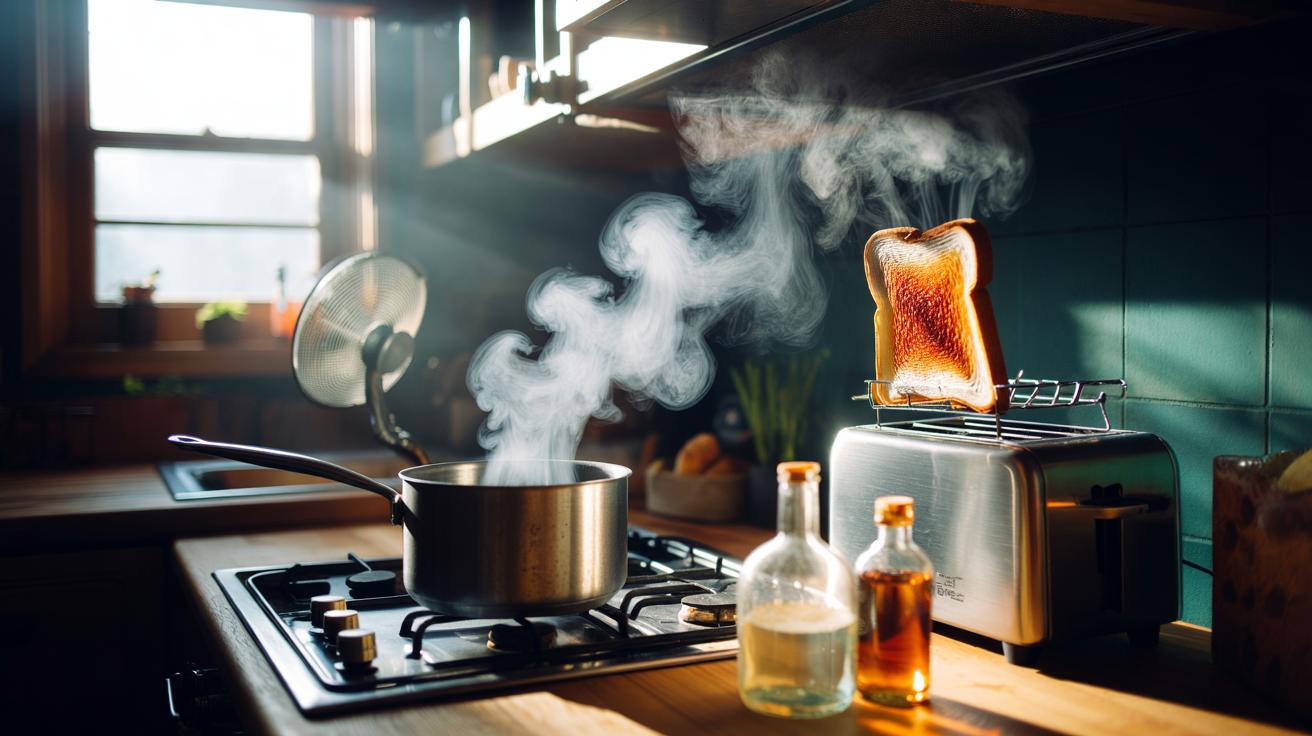
Speed is your ally. Kill the heat, open a window, and build your haze. Pour a cup of white vinegar into a saucepan with three cups of water (a rough 1:3 to 1:4 ratio works well). Simmer until you see a gentle plume. Keep the pan where the smoke was worst. Short, sharp bursts beat a rolling boil. The goal is microdroplets, not a sulphurous sauna.
No hob free? Kettle trick. Add a splash of vinegar, boil once, then let the steam drift under cabinets and across the ceiling where odours loiter. Wipe hard surfaces with the cooled solution to strip films that keep re-emitting stink. Soft furnishings benefit from distance: set a bowl of warm vinegar solution nearby so the air above it stays mildly acidic, but don’t soak the fabrics. A small desk fan behind the pan pushes the haze through the room, and out. Move the mist, don’t drown the space. Fifteen minutes is often enough to reset the air and your mood.
Safety, Limits, and the Science Caveats
Acetic acid is food-safe, but it’s still an acid. Keep the vapour gentle, avoid leaning over concentrated steam, and don’t deploy near sensitive stone surfaces or uncoated steel that can pit with repeated exposure. Never mix vinegar with bleach; you’ll make chlorine gas. If anyone in the home has asthma, go low and slow—fine vinegar haze can tickle airways. Pets? Offer an escape route; their noses are stronger than ours.
There are limits. Oily soot embedded in fabric won’t surrender to vapour; it needs laundering. Soot on ceilings needs cleaning, not chemistry. Vinegar won’t neutralise carbon monoxide or fix poor ventilation. And remember olfactory adaptation: your nose tires of a smell after minutes, so “gone” can mean “I’ve stopped noticing.” The better test is a fresh nose or stepping outside and back in. Used wisely, though, the method is robust: it neutralises alkaline offenders, captures soluble aldehydes, and cuts the sharp edge that makes burnt toast so bossy in small British kitchens.
Vinegar vapour wins by moving the chemistry into your favour: it pulls problem molecules out of the air, tames their volatility, and makes the room feel breathable again. It’s fast, frugal, and reassuringly low-tech. Next time breakfast goes black, a little acid fog and a fan might save the day—and your curtains. The simplest tools are often the most elegant. What other household haze hacks deserve a second look in the fight against domestic odours?
Did you like it?4.4/5 (30)