In a nutshell
- 🧠 Memory anchoring pairs ideas with distinctive cues, leveraging encoding specificity and cue‑dependent recall to cut cognitive load while avoiding cue overload.
- ⚡ Build anchors fast: use a two‑beat gesture, a micro‑jingle, visual tags (icons, colors), or location cues; finish with a one‑minute retrieval drill.
- 🛡️ Make anchors exam‑proof with plural cues, varied study contexts, spaced retrieval, interleaving, one‑to‑one cue mapping, and a simple error signal to fix misfires.
- 🧭 Use the loop Create → Rehearse → Retrieve → Refine; keep a searchable anchor register and run a weekly audit to prune weak cues and promote strong ones.
- 🎯 Result: faster recall, cleaner thinking, and steadier performance; set one anchor today and stack more for a durable, personal cue library.
Students rarely fail because they can’t understand; they stumble because they can’t retrieve fast enough under pressure. That’s where memory anchoring changes the game. It ties new material to a vivid cue—a sound, place, gesture, image, or phrase—so the right idea pops forward on demand. The setup is quick. Seconds, not hours. Attach a cue precisely when you learn, and you’ll recall it when you need it. In lecture halls, kitchens, buses, anywhere, anchors compress time-to-remember. They feel like “instant recall,” but they’re simply well-placed hooks. Build a few today, then test them tomorrow. You’ll feel the difference.
What Is Memory Anchoring and Why It Works
Memory anchoring is the deliberate pairing of a target idea with a distinctive cue that your brain can find later. Think of it as adding a bright label to a box on a messy shelf. When the exam question appears, the cue triggers the right shelf, and the label guides you to the box. The science is straightforward: encoding specificity and cue-dependent recall show we remember best when retrieval conditions match the context at learning. Anchors increase the odds of that match, even in a sterile exam hall.
Anchors exploit associative networks. A color, a rhythm, a brief motion—each becomes a tiny lever. They also reduce cognitive load. One memorable cue stands in for multiple details, which you then unpack step by step. Beware of cue overload, though; if one anchor points to five different concepts, it loses strength. Keep anchors specific, distinctive, and repeatably triggerable. A good test: can a friend name your concept after you show them the cue? If not, sharpen it. Distinctiveness beats intensity; clean cues beat flashy, forgettable ones.
Quick Anchors Students Can Build in Minutes
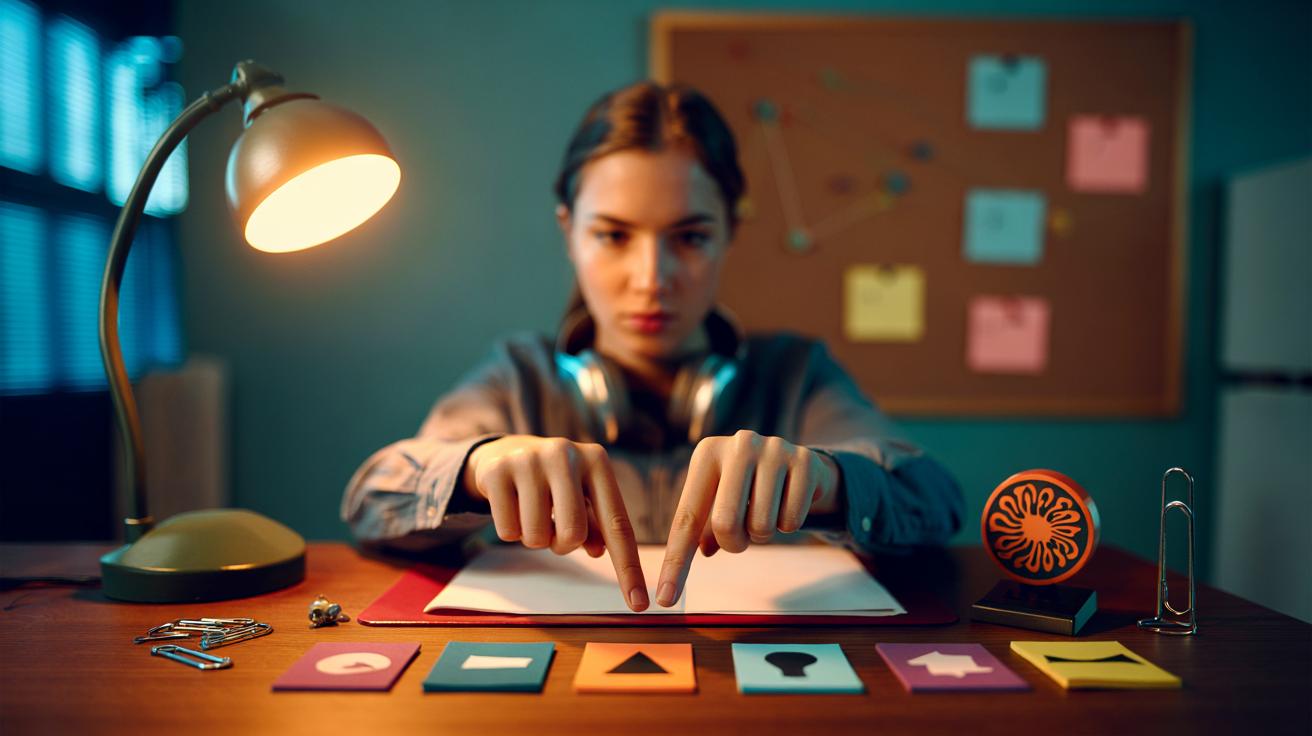
Start simple. Pair an equation with a two-beat finger tap on your desk, then repeat the tap whenever you see the formula in practice problems. The rhythm becomes the “doorbell” that summons the steps. Language learners can attach new verbs to a micro-jingle hummed under their breath; the tune calls the conjugation pattern. Create the anchor at the exact moment a concept clicks.
Use visual anchors. For cell biology, sketch a tiny mitochondrion next to ATP notes and tint it orange. Later, orange highlights act like flares for energy questions. Try location anchors too: read your case study by the window, then briefly glance at a photo of that window before practice quizzes. The mental place cues the reasoning chain. For humanities, attach themes to symbolic objects—a paperclip for “connection,” a key for “access/power”—and keep them on your desk while summarizing chapters.
Finish with a one-minute retrieval drill. Close the book, fire the cue, and list every linked idea from memory. No peeking. If the anchor fails within 24 hours, rebuild it stronger—bolder color, tighter phrase, cleaner gesture. Anchors improve fast under this pressure test.
Designing Anchors That Survive Exams
Good anchors work in quiet rooms. Great anchors work under stress. To make them resilient, give each one a plural cue: combine a short phrase (“zero-sum”), a mark (✓), and a finger tap. If one fails, the others catch. Rotate contexts during study—bedroom, library, café soundscape—so the cue isn’t trapped in one environment. Diverse practice conditions immunise anchors against exam-day surprises.
Use spaced retrieval. Fire the cue after 10 minutes, then hours, then days. Each successful pull thickens the neural path. Interleave topics so anchors don’t collide; chemistry, then a bit of history, then back to chemistry. To avoid cue overload, maintain a one-to-one mapping: one anchor, one cluster of ideas. If scope creeps, split the cluster. Add an error signal—a red dot in your notes—whenever the anchor misfires, and fix it the same day by re-anchoring with a sharper image or a cleaner phrase. Exam resilience is built by small, repeated, accurate recalls.
A Simple Framework and Tools to Track Anchors
Use a loop: Create → Rehearse → Retrieve → Refine. Creation takes under a minute: pick the cue, state the concept aloud, bind them with a sentence. Rehearsal is tiny—10 seconds per pass. Retrieval is the test; do it cold, without notes. Refinement is the craft: trim ambiguous wording, amplify distinctiveness, or swap cues that clash. Track the loop so you know what to keep and what to cut.
Keep a compact register of your anchors. Paper works. Apps work. The goal is searchable cues that you can drill before class or a quiz. Here is a quick snapshot for common subjects:
| Technique | Anchor Cue | Best For | Setup Time |
|---|---|---|---|
| Dual Coding | Icon + color strip | Processes, cycles | 30–60 sec |
| Method of Loci | Room path points | Ordered lists | 2–3 min |
| Gesture Tag | Two-beat tap | Formulas, proofs | 10–20 sec |
| Sound Bite | Three-word slogan | Definitions, rules | 20–30 sec |
Pair this with a weekly five-minute audit: strike weak cues, promote strong ones, and note any misfires. Small, consistent maintenance keeps anchors sharp and exam-ready. Over time, you’ll own a personal library of cues that travel with you from module to module.
Memory anchoring doesn’t replace deep study; it accelerates access to what you’ve already learned and makes retrieval feel effortless. A few seconds to set, a few seconds to test, and a lifetime habit emerges. Turn topics into cues, and cues into confident answers. Start with one anchor today, drill it tomorrow, and stack another the day after. Your notes won’t change, but your speed will. Which concept on your desk right now deserves its first, unforgettable anchor—and what cue will you choose?
Did you like it?4.3/5 (21)