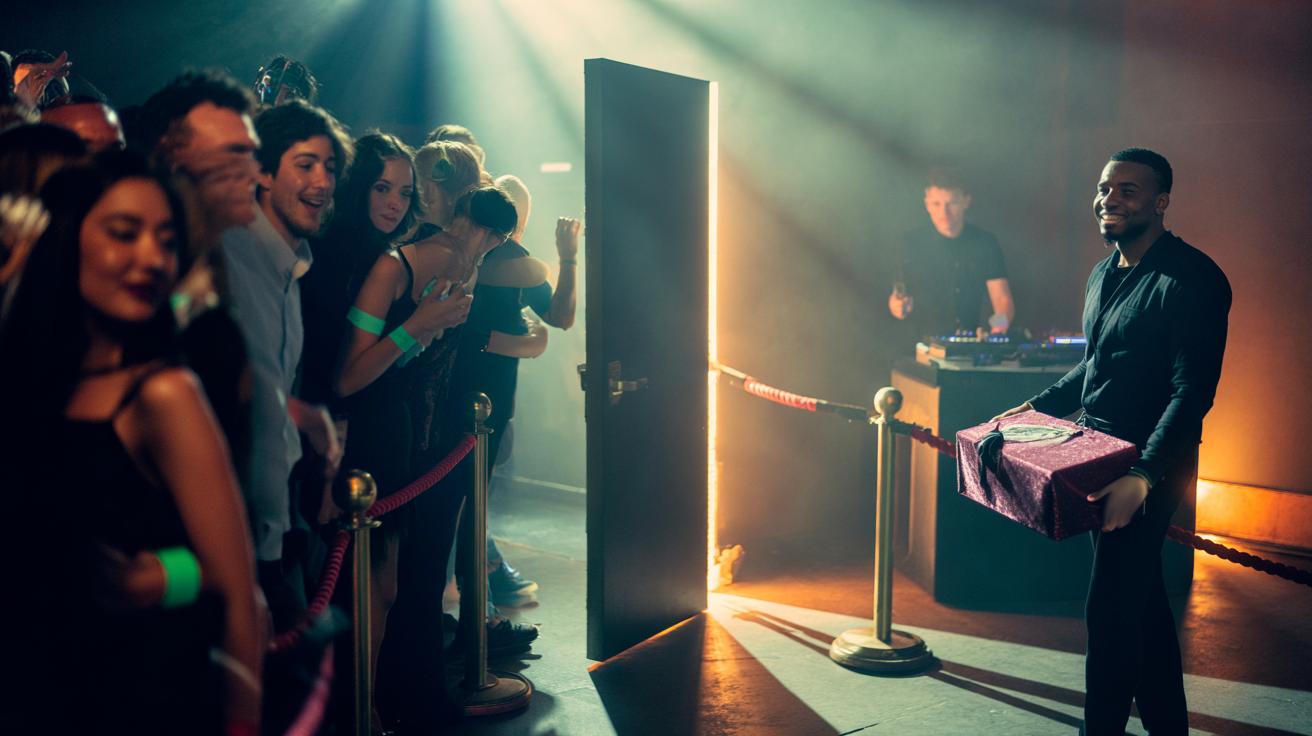
In a nutshell
- 🧠 The psychology: anticipation primes dopamine and fuels social proof, creating a self-reinforcing curiosity loop where guests “borrow” confidence from others.
- 🪄 Small signals matter: strategic micro-cues—dimming lights, held music, sealed items—use ambiguity to spark whispers and clustering by saying “not yet,” not “no.”
- 🚪 Gateways shape behaviour: queues and thresholds act as status displays; visible doors, paced entries, and partial views amplify interest without breeding resentment.
- 📣 Design for spread: use scaffolded reveals, controlled scarcity, and sonic/scent motifs while training staff as storytellers so the crowd becomes your press office.
- 🌊 Core takeaway: treat anticipation as party infrastructure; align signals for momentum with goodwill, ensuring curiosity swells—and crests—at the right moment.
Parties don’t just happen; they unfold. In that unfolding lies a fleeting but potent force: social proof fuelled by anticipation. Guests watch, measure, copy, resist, then copy again. A glance to the queue. A murmur about a secret set time. Suddenly the room leans forward. Anticipation acts like a starter pistol for the mind, sending curiosity racing toward the next reveal. When hosts prime subtle signals—lights dimming, doors cracked, whispers planted—people collaborate in a chain reaction that makes the moment feel bigger than it is. The trick? Understand how tiny cues become waves, then ride them without tipping into manipulation.
The Psychology of Anticipation and Social Proof
At its core, anticipation is a prediction game. The brain balances uncertainty and reward, releasing dopamine not only when we get what we want but when we sense it’s coming. That’s why a half-heard countdown, a warming spotlight, or a rumour of a surprise act can spark a curiosity loop. People share glances. They refresh their expectations. In social settings, we borrow confidence from others to decide whether the moment is worth our attention. That is the engine of social proof.
It scales quickly. One person peels towards a side room. Two follow, then six. A cluster forms, and in seconds a cascade develops that looks like certainty. This is the friendly cousin of FOMO: a soft tug that says, “If they care, maybe I should.” It’s not magic. It’s pattern-reading and risk-hedging. People are time-poor at parties, and cues help them allocate attention. Signal beats noise when the stakes feel low but the potential payoff—status, novelty, story value—feels high. Done well, anticipation creates a buoyant atmosphere. Done clumsily, it becomes a queue to nowhere.
Micro-Cues That Spark Curiosity Loops
Small signals move crowds. A sudden hush before a toast. A whisk of perfumed air from a half-open door. A DJ switching to a stripped-back loop, then holding it for a beat longer than seems polite. These micro-cues tell the room something is brewing, without spelling it out. Ambiguity is the fertilizer of curiosity. Hosts often over-explain, flattening the arc; a better move is to dial up contrast and let guests connect dots. Place a prop where it can be glimpsed but not yet touched. Let staff carry unusual items—sealed cake boxes, a velvet rope, an old camcorder—then vanish.
Consider how each cue is read at speed. People infer intent, value and timing in a blink. The best cues are legible from across the room yet deniable up close, encouraging whispers rather than announcements. The table below summarises common triggers.
| Cue | Guest Interpretation | Likely Effect |
|---|---|---|
| Dimmed lights near a door | Something is starting in there | Drift, clustering, peeking |
| Staff carrying sealed items | Scarcity or reveal incoming | Murmurs, photo-taking, wait-and-see |
| Hold in the music | Countdown without numbers | Silence, signals, phones ready |
| Selective wristbands | Tiers or timed access | Queue formation, FOMO spikes |
Design cues that say “not yet” more clearly than they say “no.” That’s the sweet spot where curiosity swells rather than sours.
The Dynamics of Queues, Doors, and Thresholds
Queues are Britain’s unofficial operating system, and parties obey the same logic. When space narrows—at a bar, a cloakroom, a closed door—people self-organise. The queue becomes a status display as much as a waiting mechanism. If the door is opaque and the sound leaks are rich, the line surges. If the door yawns open and reveals a half-empty room, interest collapses. Thresholds are theatres; use them deliberately. A sliver of view, a guard who smiles but doesn’t move, a sign that hints at capacity: these make the doorway feel like a story turn.
Positioning matters. A threshold that can be seen from the main room invites public curiosity and performs social proof live. One tucked away creates an insider feel but costs momentum. The velvet-rope effect works because it blends scarcity with legibility: everyone can see the rule, so compliance feels fair even when access is limited. Still, misjudge it and you create resentment. Pace arrivals, seed early clusters, and allow periodic spill to stop the queue ossifying. People endure waiting when they see movement, meaning, or magic ahead. Remove all three, and even the most patient crowd peels away.
Designing Party Moments that Travel
To trigger curiosity waves that ripple beyond the room, build moments with carry—something guests retell, record, remix. Start with scaffolded reveals: a teaser at :15 past the hour, a partial reveal at :30, the main act at :45. Use controlled scarcity—limited cocktails in distinctive glassware, a one-song live cameo, a polaroid station with finite film—so early adopters become mobile billboards. Let the crowd be the press office. Give them props with narrative hooks: stamped napkins, cryptic stickers, lyrics tucked into pockets.
Sound and scent travel faster than flyers. A motif—two rising notes, a chime, a citrus burst—can act as a bat-signal that the next chapter is loading. Recruit staff as storytellers, not bouncers; a raised eyebrow can launch ten guests towards the right corner at the right time. Crucially, set ethical guardrails. Avoid fake exclusivity that humiliates or divides. Offer parallel delights so those outside the rope aren’t stuck in purgatory. The goal is momentum with goodwill. When people feel included, their posts, texts, and whispers compound into wider social proof, carrying your party’s energy into the city night.
Anticipation isn’t decoration; it’s infrastructure. Craft it with care and your gathering gains shape, pace, and memory. Let cues contradict, and curiosity stalls. Get them crisp, and the room breathes as one—leaning in, looking up, letting go. Design for the moment, but also for the story that leaves with guests at closing time. The next invite will ride today’s echoes. So, when you plan your next party, which signals will you deploy to spark curiosity without sacrificing warmth—and how will you know the wave has crested at just the right height?
Did you like it?4.6/5 (29)